


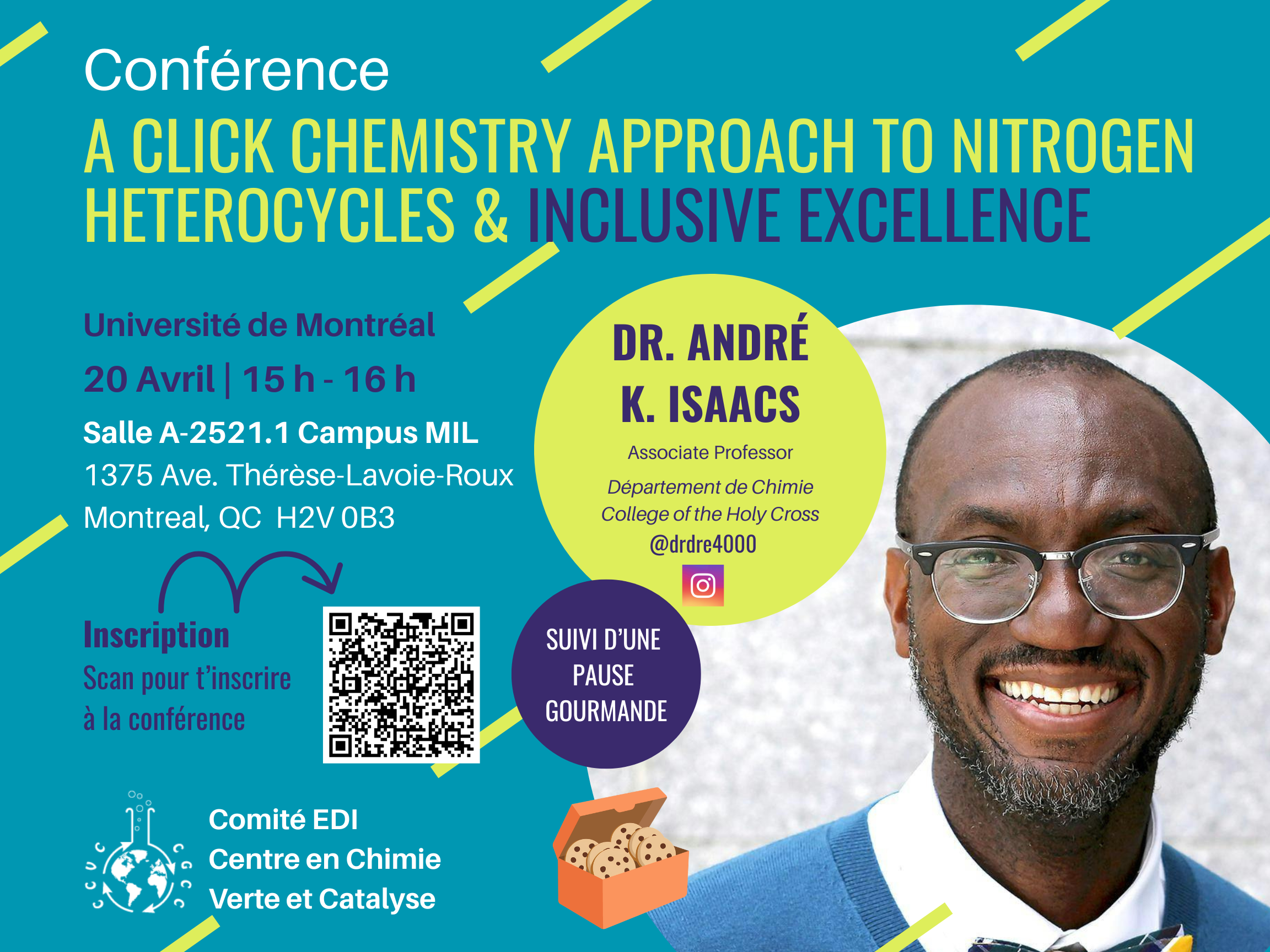
- Salle A-2521.1, Campus MIL, Université de Montréal
- 15 h 00 min - 16 h 30 min
- 20 avril 2026
Le comité Équité, Diversité et Inclusion du Centre en Chimie Verte et Catalyse a le plaisir d’annoncer un séminaire présenté par le Prof. André K. Isaacs, intitulé :
« A Click Chemistry Approach to Nitrogen Heterocycles and Inclusive Excellence ».
Ce séminaire mettra en lumière des avancées de pointe en chimie organique de synthèse, en particulier l’utilisation de la chimie clic comme stratégie efficace pour la synthèse d’hétérocycles azotés — des structures essentielles dans de nombreux composés pharmaceutiques.
Au-delà des aspects scientifiques, le Prof. Isaacs proposera également une réflexion sur des approches pédagogiques innovantes visant à favoriser une plus grande inclusion dans les domaines des sciences, technologies, ingénierie et mathématiques (STIM). Il abordera notamment des stratégies d’enseignement et de mentorat adaptées aux nouvelles générations, avec une attention particulière portée aux étudiant(e)s issus de groupes historiquement sous-représentés.
Informations pratiques
📅 Date : Lundi 20 avril
🕒 Heure : 15 h à 16 h (suivie d’une période de questions)
📍 Lieu : Salle A-2521.1, Campus MIL, Université de Montréal
💻 Format : Comodal (présentiel et en ligne)
La participation en présentiel est encouragée, en particulier pour les étudiant(e)s du Campus MIL.
👉 Lien d’inscription (le lien de participation en ligne sera envoyé aux personnes inscrites).
Le résumé détaillé et la biographie du conférencier sont disponibles en anglais:
Abstract
« My research interest is centered on a very reliable organic reaction – the copper-catalyzed cycloaddition of sulfonyl azides and terminal alkynes (CuAAC) commonly known as ‘click chemistry’. Fragmentation of the resulting 1,2,3-triazole generates reactive intermediates which can be intercepted to synthesize nitrogen heterocycles. Nitrogen heterocycles are important structural components in a majority of pharmaceutical drugs. This seminar will also focus on modern strategies that capitalize on the unique learning styles of the younger generation, with special attention to students from historically marginalized groups, to broaden participation in STEM. I will discuss how to incorporate Gen-Z culture in the classroom, tools for students to educate themselves and how to fuse digital media with academic learning. »
A bit about Prof. André K. Isaacs
A native of Jamaica, André moved to the US to attend the College of the Holy Cross where he received his B.A. in Chemistry in 2005. As an undergraduate, he conducted research in the labs of Kevin J. Quinn focusing on the total synthesis of annonaceous acetogenins Muricatacin and Rollicosin. He received his PhD from the University of Pennsylvania in 2011 (under the guidance of Professor Jeffery D. Winkler), where he focused on the design and synthesis of novel steroid-derived inhibitors of Hedgehog-signaling, based on the alkaloid cyclopamine. He worked as a post-doctoral researcher with Professor Richmond Sarpong at the University of California, Berkeley, where he focused on the synthesis of diterpenoids and the radiolabeled insecticide chlorantraniliprole. In 2012, Andre accepted a tenure-track position at the College of the Holy Cross. In 2018, Andre was promoted to the rank of Associate Professor with tenure. In addition to teaching courses in Organic Chemistry, Andre conducts research utilizing copper-mediated organic transformations. He is one of the co-founding members of Outfront – the college’s LGBTQ faculty and staff alliance and serves as faculty advisor to several student groups including the Caribbean African Students’ Assemblage, acapella group Fools on the Hill and Club Tennis.