

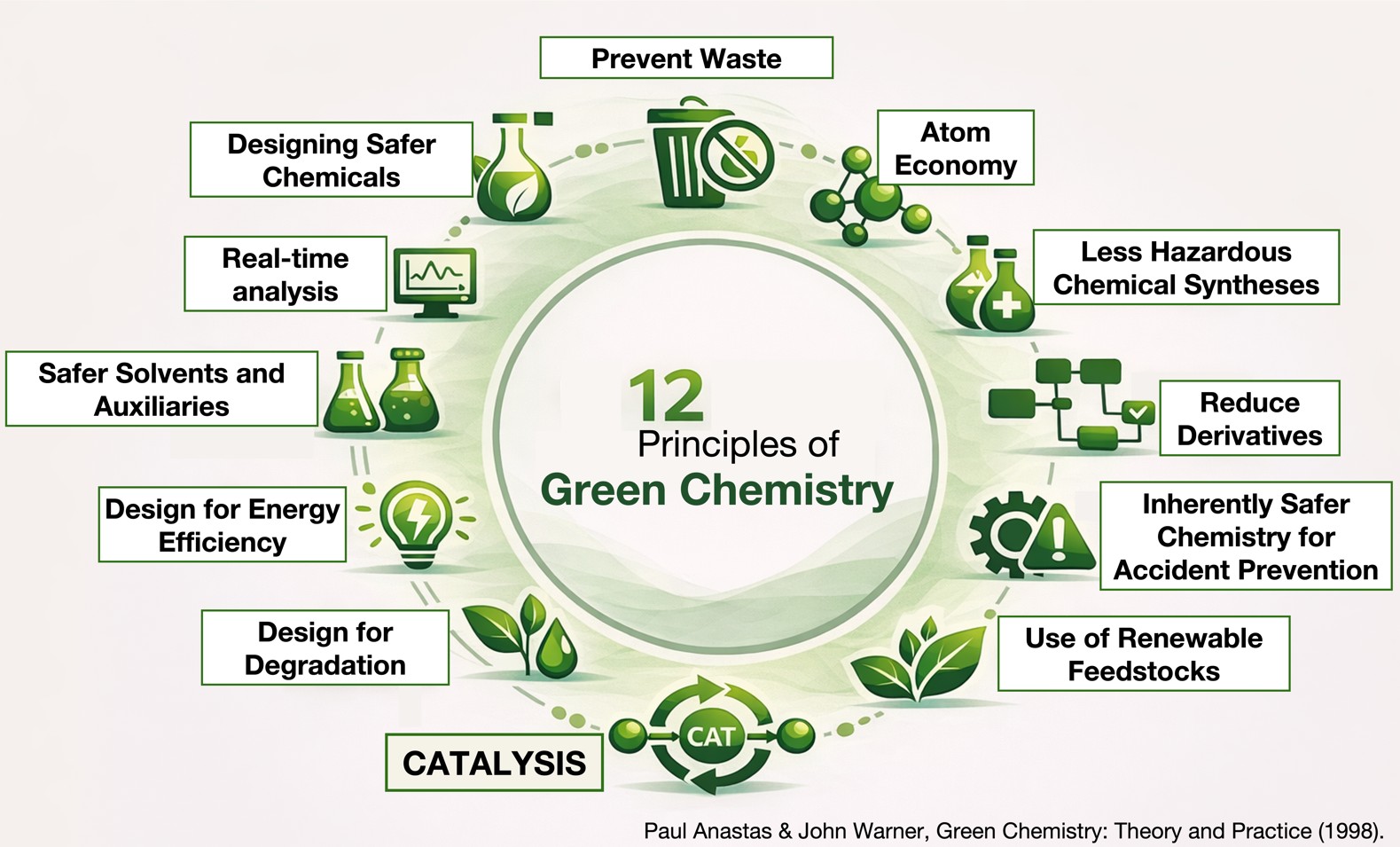
The CGCC supports research activities related to the synthesis and use of chemicals that align with sustainable development criteria. Green chemistry involves applying a set of principles that aim to reduce or mitigate the use or production of hazardous substances in the design, manufacture, and use of chemicals.
Research Areas
Catalysis lies at the heart of these principles and is one of the CGCC's primary axis. Its research program consists of five interrelated themes that promote the development of green molecules and processes in the following axes:
Axis 1: Invention of catalytic reactions
Leads: BOFFITO, Daria Camilla – Polytechnique Montréal and COLLINS, Shawn – Université de Montréal
Principals: Arndtsen, Auclair, Bohle, Bélanger Chabot, Claire Da Silva, Forgione, Hanan, Kopyscinski, Légaré, Moitessier, Ottenwaelder, Paquin, Patience, Pelletier, Quaglia, Schaper
Collaborating: Charette, Do, Gleason, Hazlett, Iliuta, Lebel, Li, Lumb, Ollevier
Catalysis provides an avenue to redesign how molecules are prepared and is thus a key aspect of Green Chemistry and sustainability efforts. Axis members will engage in all forms of catalysis as they are inherently complimentary. Homogeneous catalysis is often the entry point to reaction discovery and will be exploited to create innovative routes to pharmaceuticals or polymers, renewable resource utilization (Axis 3) or light-driven catalysts (Axis 2). These can be interfaced with heterogeneous catalysis, which offer routes to recycle catalysts and high stability, and as such are key for large-scale applications. Nature’s catalysts, biocatalysts, are extraordinarily effective systems that can function in a Green solvent, water (Axis 2), and be deliberately modified to enhance their performance for the creation of pharmaceuticals or other fine chemicals.
Axis 2: Tools for Green synthesis
Leads: CHARETTE, André – Université de Montréal and OLLEVIER, Thierry – Université Laval
Principals: Boudreault, Bélanger, Canesi, Cecioni, Claverie, Damha, Gleason, Guindon, Lubell, Nazemi, Schmitzer, Spino, Vallée-Bélisle, Wilds
Collaborating: Auclair, Collins, Cosa, Forgione, Harrington, Lavoie, Leonard, Li, Lumb, Légaré, Moitessier, Paquin, Wuest
This Axis explores the development of fundamentally new ways to make molecules in a Green fashion and to integrate these new routes with emerging technologies to augment their sustainability. Examples include replacing toxic solvents with benign alternatives, using no solvent conditions via mechanochemistry, or exploiting hotochemistry to cleanly make or break bonds. Alternatively, continuous flow synthesis offers a route to readily scale processes and has become the industry standard for producing key reaction intermediates.
Axis 3: Transformation of renewable resources
Leads: MACGILLIVRAY, Leonard – Université de Sherbrooke and LI, Chaojun – McGill University
Principals: Bougie, Fontaine, Harrington, Howarth, Iliuta, Larachi, Lavoie, Lumb, McCalla
Collaborating: Boffito, Kopyscinski, Moores, Patience, Vallée-Bélisle
The conversion of biomass and other abundant resources into valuable products creates new opportunities for Québec's bioeconomy. Axis 3 seeks to move from an existing petrochemical-based chemical industry to one based on abundant materials occurring in Nature. Examples include the valorization of waste chitin, lignin and cellulose into Earth-friendly plastics, the conversion of CO2 to valuable commodities, and Green methods to refine metals. Axis 3 naturally interacts with the other Axes through its use of catalysis (Axis 1), exploiting clean reaction tools (Axis 2), or biomass derived molecules for energy storage (Axis 4).
Axis 4: Exploring the Green Chemistry energy advantage
Leads: GOULET, Marc-Antoni – Concordia University and LEBEL, Hélène – Université de Montréal
Principals: Do, Dollé, Fontaine, Hamzehpoor, Hazlett, Majewski, Rochefort, Santato, Wuest
Collaborating: Arndtsen, Canesi, Claverie, Fontaine, Hanan, Larachi, McCalla, Ottenwaelder
Addressing energy use is a key aspect of Axes 1-3, as the chemical enterprise consumes an ca. 15% of the World’s energy. Axis 4 looks to build on this energy thrust in a different direction: to create clean technologies to facilitate the drive toward renewable energy use and thus help enable Québec’s “Plan for a Green Economy” by doing so sustainably. This new Axis explores Green molecular solutions to energy storage and catalytic methods to harness renewable energy. Key to Axis 4 success is its interplay with the other Axes: Green synthesis (Axis 2) will be used to prepare electroactive organic molecules for redox flow batteries, photoactive catalysts (Axis 1) exploited to generate ‘Green hydrogen’ (H2) fuels from water, or earth abundant metals (Axis 3) used to create new batteries.
Axis 5: Evaluation and policies in Green Chemistry
Leads: GHOSHAL, Subhasis et MOORES Audrey
Principals: Bulle, Cosa, Hamoudi, Jordaan, Larivière, McKeague, Thibodeaux
Green Chemistry advances must be carefully evaluated at every step to ensure they are truly benign and thus fulfill the goals of Green technologies. While these issues have not historically been a priority for many scientists, they are crucial to ensuring that the field moves forward. Axis 5 researchers will explore the environmental fate and toxicity of products, apply Green Chemistry metrics to discoveries made in each the Axes above, and integrate our advances with policy development to inform policy experts of new advances as well as accelerate the adoption of new technologies. In addition to their research, Axis 5 members will carry out workshops to help integrate these tools into the efforts of other CCVC members.